



A town hall meeting hosted by the UNC-Chapel Hill Student Government’s Executive Branch brought students into Fetzer Hall. There, they discussed the future of UNC without diversity, equity and inclusion.
Student body president, Jaleah Taylor, and her administration invited former DEI vice-provost Leah Cox on Wednesday to talk about the new environment around these initiatives on campus. Executive branch DEI co-directors, Elise Ramos and Alexandra Versace, led the conversation where ‘student success’ and ‘institutional neutrality’ replaced commonly used words like ‘diversity, equity, and inclusion.’
“The policy itself maintains many rights that protect diverse populations. However, the language used by this new policy such as “political controversies” and “institutional neutrality” as an argument to take away the DEI department and other institutional initiatives primarily serving diverse populations; makes it seem like diverse populations are something of controversy, and their needs for success are in violation of “institutional neutrality”. I’m not sure what’s controversial about diversity. Or supporting the efforts of diversity,” Ramos said.
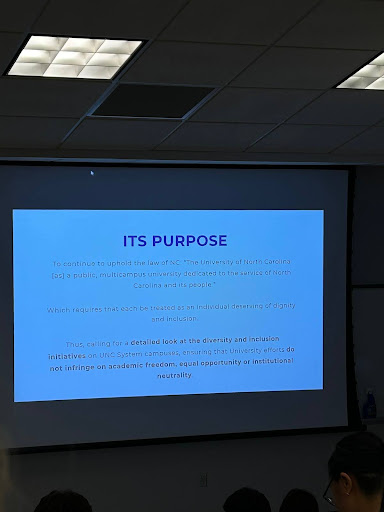
Information provided during the meeting’s lecture said the University’s role is to ensure intellectual freedom and free expression protected by the First Amendment. According to the information provided by the Taylor administration, UNC plans to uphold the idea of ‘institutional neutrality’ by allowing all individuals to share ideas or opinions without limitation. This includes ideas that may be unwelcome and/or deeply offensive.
The UNC System Board of Governors repealed Section 300 of the Equality Policy in May. It was officially put into effect on Sep. 1. Cox said the UNC System and UNC-CH have refocused their efforts around general student success rather than diversity, equity, and inclusion. These changes have taken place on all UNC System campuses.
“We can’t have centers for DEI, we can’t have offices for DEI, we can’t have programs that are targeting any specific group,” Cox said.
The removal of Section 300 does not directly affect students or faculty in academic discourse or personal expression, but restricts faculty and staff from requiring individuals to publicly express a view of social policy. In efforts to remain neutral the University plans to refrain from speaking on “political controversies of the day.”
“We recognize the world we live in now, if you haven’t registered to vote; get it together, ” Cox said.

The Executive Branch co-directors said there are exceptions for student-led organizations. In compliance with each institution’s university resource policy, all student-led organizations can use university facilities, and receive funding even if their speech or expressive activities would normally violate the University’s ‘institutional neutrality.’
Students, student groups, or faculty members are also able to invite any speaker without restrictions from the University. However, there are a range of ‘disciplinary sanctions’ that are enforced to anyone who substantially disrupts the functioning of the university, or interferes with the protected free expression rights of others.
“There could be more to come, and it worries me, and I hope it worries you which is why it’s better to be proactive,” Cox said.
Students expressed their concerns about the social changes UNC-Ch will experience after the removal of DEI-based programs like SPARK, the DEI Fellows, and Project Uplift. Under the newly revised policy, the DEI Fellows were eliminated, but according to Cox programs like SPARK and Project Uplift will continue on the basis that all students can participate.

The Harvey E. Beech Scholarship, which is an award originally given to Black seniors and alumni, will also continue but be open to all students. Students also questioned Student Government officials about how the removal of DEI amidst the elimination of Affirmative Action will affect the admission of minorities, especially Black, students on campus.
“If there aren’t that many [Black] people, then I feel the loss of identity or the loss of responsibility will come,” Josiah Young, UNC sophomore, said.
According to UNC-CH’s annual demographics report, UNC Admissions admitted 25% less Black students into the 2028 class. Cox said determining what caused the drop in Black UNC admits is difficult because there are many new influential factors. Versace, DEI co-director, said the Taylor administration plans to meet with Rachelle Feldman, vice provost of enrollment.
“We all see the Black student admission rate drop by 25%, which is drastic,” Versace said.
She added that students should remain hopeful.
“But we are having a meeting with [UNC-Ch] Admissions to see if there is anything we can do,” Versace said.
There have been no further DEI policy changes made at this time.


