


By: Salena Braye-Bulls (’23), Staff Writer
I drive a lot. Like a lot. Like “60,000 miles in two and a half years” a lot.
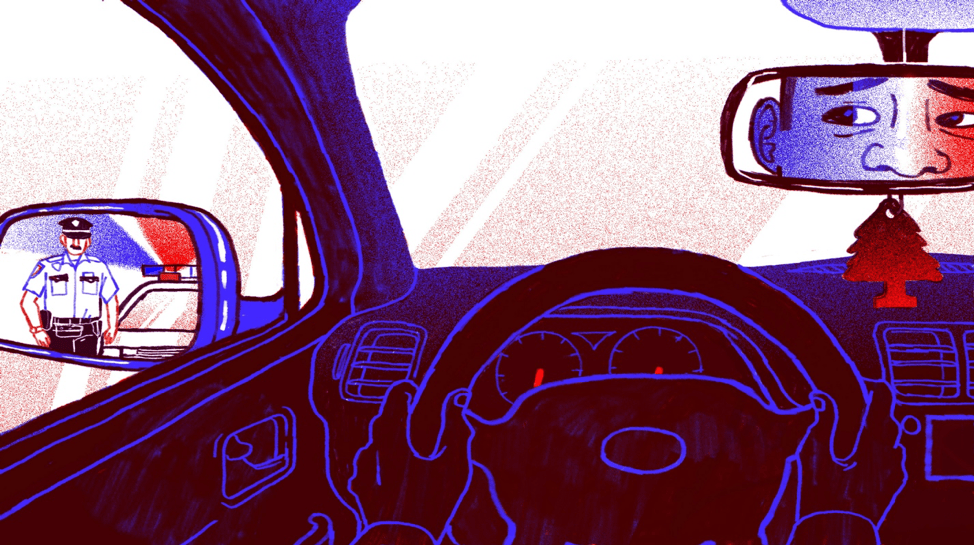
I’m aware of my driving’s toll on my Volkswagen Jetta, and as a young Black woman who primarily travels through the Deep South, I’m also aware of the risk I take each time I turn on my ignition. Every ride poses the possibility of a dangerous encounter with law enforcement. In addition to being fearful of car accidents and flat tires, I also worry that, at some point, a police officer might pull me over and I’ll be in an all too unsettling situation.
I’ll remember the things that Black people in the U.S. continuously remind each other to do. I’ll recall my rights, keep my hands where officers can see them and not make any sudden movements. I’ll even call my mother and have her on the speaker phone. This muscle memory – of doing everything to protect yourself from police and knowing that it may not be enough – is the product of systemic racism and state violence. It’s part of the reality of driving while Black.
Recently, Daunte Wright was killed by Brooklyn Center police officer Kimberly Ann Potter in a traffic stop. Wright, a young and bright father, was pulled over and shot when Potter allegedly thought that her pistol was a taser. That same weekend, Caron Nazario, an Afro-Latino man, was pepper-sprayed at point-blank range by two cops in rural Virginia. Brakkton Booker of Politico noted that neither Wright or Nazario posed any danger to those officers or society when they were pulled over. He writes that to American police officers, Black people’s Blackness can always be justification for traffic stops that turn deadly far too often.
Booker furthers that the danger of driving while Black, or DWB, has to be included in larger conversations about race, policing and brutality. The police use their sanctioned power in their precincts and local neighborhoods, but they also weaponize their authority on streets, county roads, and highways. Black people often experience state violence in these spaces, and this unjust fact has been noted time and time again.
In 2018, political research faculty at the University of South Carolina authored a book that delved into data on 14 years of traffic stops in North Carolina. The book, Suspect Citizens: What 20 Million Traffic Stops Tell Us About Policing and Race, objectively described the numbers behind DWB. Its authors found that Black drivers were 63% more likely to be stopped on roads even though they spend 16% less time on the road than white drivers, and that Black drivers were 115% more likely than white drivers to be searched. So, not only are Black drivers disproportionately being stopped, but they’re also disproportionately being illegally searched and antagonized. These disparities aren’t exclusive to North Carolina; similar statistics have been recorded in Florida, Missouri and other states.
The previously mentioned authors aptly describe what DWB metrically looks like, but I can tell you what it feels like. It feels like anxiety, anger, frustration, and pain. When Black people are assaulted or killed by police officers in traffic stops, law enforcement apologists are quick to mention things that led to initial interaction. They presume that anti-Black violence will always be reasonable. They think, “surely Sandra Bland, Philando Castille, and Walter Scott had to have had police violence coming towards them because of their choices”. Well, I know that no warrant, expired license plate, or alleged smell of marijuana calls for police brutality. Nothing ever will.
‘Driving while Black’ extends beyond discrimination. It is the blatant and normalized criminalization of Black people doing a necessary task. Driving while Black is a side effect of simply existing while Black in America. It is only one dimension of oppression that Black people experience daily. We are not allowed to shop, eat, work, or drive without an underlying anxiety about what might happen to us just for being us.
Derek Chauvin, the officer who murdered George Floyd, was recently found guilty of homicide. Many are understandably calling this a measure of “accountability”. I just want to drive without fear of a police officer deciding to violently hold me “accountable” for something I didn’t do. I just want to drive without fear.
Articles:
https://www.sc.edu/uofsc/posts/2020/06/racial_disparities_traffic_stops.php#.YH-TuRNKiEs


